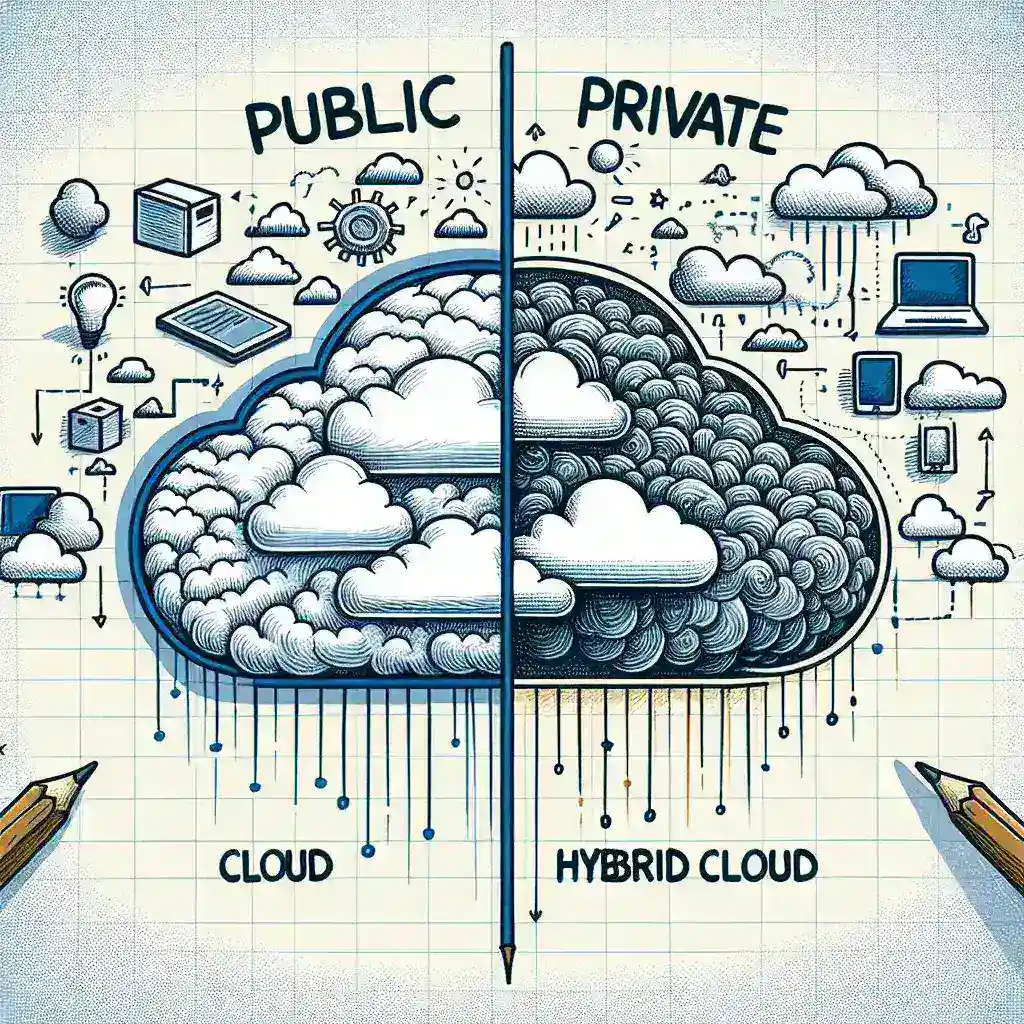
The advent of cloud computing has revolutionized the way businesses operate, offering scalable, flexible, and cost-effective solutions. The three primary types of cloud computing are Public, Private, and Hybrid clouds. Understanding the differences, benefits, and scenarios where they shine best is crucial for businesses looking to optimize their IT infrastructure.
Overview of Cloud Types
Here’s a comparative overview of Public, Private, and Hybrid clouds:
| Aspect | Public Cloud | Private Cloud | Hybrid Cloud |
|---|---|---|---|
| Deployment | Off-site, third-party provider | On-site or via third-party vendor | Combination of both |
| Scale | Highly scalable | Limited by private resources | Scalable using public cloud |
| Cost | Pay-as-you-go | Capital expenditure | Combination of both |
| Control | Limited user control | Full control | Balanced control |
| Security | Standard security | Enhanced security | Mixed security |
Public Cloud
The public cloud is a type of cloud computing where services are delivered over the public internet and shared across various organizations. It is managed by third-party cloud service providers like Amazon Web Services (AWS), Microsoft Azure, or Google Cloud Platform.
Benefits of Public Cloud
- Cost-Efficiency: The public cloud operates on a pay-as-you-go model, ensuring you pay only for the resources you use, which can significantly reduce costs.
- Scalability: With virtually limitless capacity, the public cloud can quickly scale to meet fluctuating demands without the need for significant investments.
- Accessibility: As services are provided over the internet, public clouds offer anytime, anywhere access to resources.
Drawbacks of Public Cloud
- Security Concerns: Since the infrastructure is shared among multiple organizations, there can be increased security and compliance risks.
- Limited Control: Users typically have less control over their infrastructure and data compared to private cloud solutions.
Private Cloud
Private cloud computing is dedicated solely to one organization. This infrastructure can be hosted on-site or by a third-party service provider. It provides a higher level of security and control compared to the public cloud.
Benefits of Private Cloud
- Enhanced Security: With a dedicated infrastructure, private clouds offer greater security and data protection.
- Customization: Private clouds can be tailored to meet the specific needs and compliance requirements of an organization.
- Control: Organizations have complete control over their environments, enabling them to manage resources and data more effectively.
Drawbacks of Private Cloud
- Cost: Implementing and maintaining a private cloud can be expensive due to capital expenditures on hardware and software.
- Scalability: Scalability is limited by the resources available within the private cloud infrastructure.
Hybrid Cloud
A hybrid cloud combines both public and private cloud environments, allowing data and applications to be shared between them. It provides businesses with greater flexibility and more deployment options.
Benefits of Hybrid Cloud
- Flexibility: Organizations can leverage the benefits of both public and private clouds, optimizing workloads based on their needs.
- Cost Management: Businesses can balance cost-efficiency by utilizing public cloud resources while retaining critical workloads in the private cloud.
- Enhanced Security: Sensitive data can be kept in the private cloud, while other data and applications can utilize the public cloud.
Drawbacks of Hybrid Cloud
- Complexity: Managing a hybrid cloud setup can be complex due to the need for seamless integration between public and private environments.
- Compliance: Ensuring compliance across both cloud environments can be challenging and time-consuming.
Use Cases
Public Cloud Use Cases
- Startups and SMEs: Ideal due to low initial investment and scalable resources.
- Development and Testing: Provides an ideal environment for developers to test applications without worrying about infrastructure costs.
- Big Data Analytics: Offers the necessary computing power to process and analyze large data sets.
Private Cloud Use Cases
- Financial Services: Requires high security and compliance, making private clouds ideal for handling sensitive financial data.
- Healthcare: Ensures the security and confidentiality of patient information, meeting stringent regulatory requirements.
- Government Agencies: These agencies often require enhanced security and control over their data infrastructure.
Hybrid Cloud Use Cases
- E-commerce: Can handle varying traffic loads by utilizing public cloud scalability while keeping sensitive customer data secure in a private cloud.
- Disaster Recovery: Utilizes public cloud for backup and recovery while maintaining core services in the private cloud.
- Application Modernization: Facilitates modernization while ensuring legacy systems remain secure and functional.
Conclusion
Choosing the right cloud solution depends on the specific needs and goals of an organization. The public cloud offers scalability and cost-efficiency, making it suitable for businesses looking to minimize investments. Private clouds, with their enhanced security and control, are ideal for enterprises with stringent regulatory and compliance requirements. Hybrid clouds provide a blend of both, offering unrivaled flexibility and adaptability to changing business needs. Understanding these cloud solutions and their unique benefits enables businesses to make informed decisions, optimizing their IT infrastructure for the future.